Branding
May 21, 2026

Marketing teams ask the same question every time illustration comes up in the budget: does it actually pay off? The honest answer is yes, but only if you understand where illustration creates value and where it doesn't.
This is the ROI case for illustration marketing: not the "custom is nicer than stock" argument, but the data-backed business argument for where custom art moves the needle.
Human brains process images faster than text, but not all images are equal for attention and retention. Custom illustration has three properties that stock photography often lacks:
Distinctiveness. A custom illustration is visually unique. Your audience hasn't seen it before and won't see it on a competitor's site next week. Novelty captures attention. Stock imagery, by contrast, is pattern-matched and skipped, the same way banner ads are ignored after repeated exposure.
Specificity. Illustration can show exactly what you mean to show: a specific product flow, a specific metaphor, a specific character that represents your user. Photography requires the right shot to exist. Illustration can depict anything.
Consistency. A well-defined illustration style is infinitely repeatable. The same visual language applies to your website hero, your social content, your pitch deck, your onboarding emails. Photography is harder to systematize at that scale.
A Venngage study found that original illustrations and infographics were the top-performing visual content types in marketing, significantly outperforming stock photos for engagement and shareability. Stock photos specifically were listed as the least successful visual content type. (For a guide on what to commission and what actually gets shared, see infographic design: what to commission and what actually gets shared.)
The mechanism isn't mysterious. Audiences have been exposed to stock imagery at scale for decades. Their pattern-recognition systems treat it as filler. Custom illustration breaks that pattern.
For blog content specifically, posts with custom illustrations see higher average time-on-page and lower bounce rates compared to posts using stock imagery. The illustration signals investment in the content, which correlates with quality expectations that keep readers reading.
Not every marketing context benefits equally from illustration. The highest-return uses:
The hero is the highest-stakes visual in your marketing funnel. It's the first thing visitors see and the primary driver of their decision to keep reading or bounce. A distinctive custom illustration communicates brand personality instantly in a way that a generic stock photo or gradient blob cannot.
SaaS companies with custom illustration in their hero sections consistently report better brand recall in customer surveys than those using photography, because there's something memorable to recall.
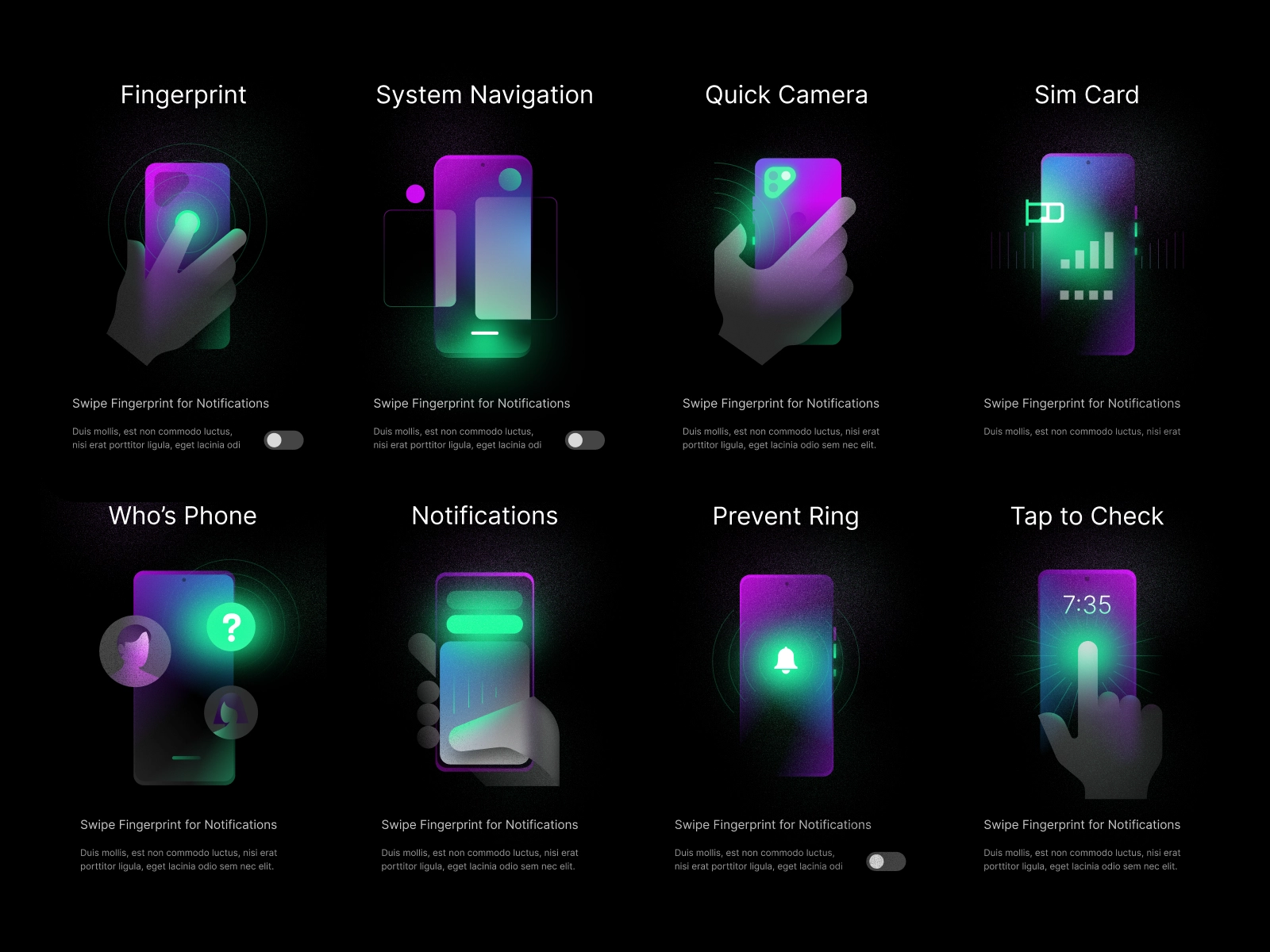
Illustration is uniquely effective for explaining complex workflows, processes, or abstract concepts. The best product onboarding sequences use custom illustration to guide users through unfamiliar interfaces with visual clarity that screenshots alone can't provide.
For SaaS companies, better onboarding directly reduces churn. If illustration gets more users to their first "aha moment" faster, the ROI is measured in retention, not just aesthetics.
Custom illustrations make articles, guides, and resources more shareable and more memorable. Unique visuals that represent the core idea of a piece are more likely to be saved, shared, and cited than posts with no visual distinction.
Illustration on social outperforms photography for most B2B brands, particularly in feed environments where photography blends into personal content. A distinctive illustration style creates pattern recognition over time: audiences start to identify your brand before reading the caption.
For funding rounds, the visual quality of your materials signals how seriously you take the business. Custom illustration in a pitch deck communicates intentionality. Generic stock imagery communicates "we grabbed what was available." The difference matters when investors are evaluating team quality and execution discipline.
The ROI of illustration marketing isn't universal; it depends on where it's deployed and what it's replacing.
A useful framework: identify the touchpoint, estimate the conversion impact, and work backwards.
If your homepage hero conversion rate is 4% and improving it by 1.5 percentage points generates 15 additional trials per month, and each trial has a $2,000 LTV, that's $30,000/month in incremental value from a design change that might cost $2,000-$5,000 once.
That math changes completely if you're applying illustration to a low-traffic page with minimal conversion impact. Choose where to invest based on traffic volume and conversion stakes, not just where illustration would look nice.
The traditional route to custom illustration (a dedicated illustrator or brand studio) costs $5,000-$15,000 for an initial illustration system. That's out of reach for most growth-stage teams.
The alternative is a design subscription that includes illustration as part of a flat monthly rate. You get the same senior illustrator quality, a defined style that's consistently yours, and the ability to produce ongoing illustration content without per-piece billing.
Jamm covers custom illustration as part of the same subscription that handles web design, branding, and product design. If your marketing needs custom art at scale, see our work or book a call to talk through the scope.
One reason custom illustration delivers compounding ROI (unlike photography) is that a well-built asset library gets more valuable over time, not less. The illustration style you define once becomes the foundation for every visual asset your team produces going forward.
A reusable illustration library typically contains: a character system with defined proportions, expressions, and poses; a set of scene backgrounds that work across contexts; a library of objects and props relevant to your product's world; and a color system with variants for light and dark contexts.
Once that foundation exists, producing a new illustration for a campaign, a new blog post header, or a new onboarding screen takes hours instead of days. You're extending an existing system rather than starting from scratch. This is why brands that make an upfront investment in illustration often see cost-per-asset drop significantly over a 12-24 month period.
Photography doesn't compound this way. Each photo shoot is a fresh production effort. Stock imagery accumulates licensing costs without building brand equity. Custom illustration is one of the few creative investments that actively appreciates.


The three most common pushbacks from marketing teams, and the honest responses:
"We can't afford it right now." The actual question is whether the ROI justifies the cost at your current stage. If you're pre-traction with an unvalidated product, this objection is reasonable — save the investment for when you know what you're communicating. But if you're scaling marketing and spending on paid channels, the comparison isn't "illustration vs. nothing." It's "illustration vs. the next $5,000 in ad spend." Custom illustration for your highest-traffic pages typically pays back faster than additional ad spend on the same page.
"We can use AI tools for this." AI-generated illustration has improved dramatically and is genuinely useful for rapid ideation. For brand illustration intended to build lasting recognition, it has two real limitations: visual consistency across pieces is hard to maintain, and the style isn't uniquely yours. Any competitor can prompt the same model with similar inputs and get visually similar output. Custom illustration by a professional team creates something that belongs to your brand and can't be replicated.
"Our current design is fine." Fine is the point. Stock imagery is fine. Generic illustration is fine. Fine doesn't differentiate you. If your marketing goal is to build a brand that's recognizable and memorable in a crowded category, "fine" is the wrong benchmark. The question is whether your visual identity is as distinctive as your positioning claims to be.
Hire a team of top level professionals for less money than hiring a single designer. Stupid simple design subscription service to level-up your business!
Looking forward to potentially working with ya ✌️


